All-on-four dental implants are a way of replacing a full arch of missing or failing teeth using just four strategically placed implants to support a fixed set of replacement teeth. Instead of needing a separate implant for every missing tooth, the four implants are angled and positioned to make the most of available jawbone, allowing a whole arch to be restored in a single visit in many cases. The result is a set of teeth that looks natural, feels secure, and functions much like healthy natural teeth.
Key takeaways
- All-on-four uses just four implants to support a full arch of replacement teeth.
- The technique often avoids the need for bone grafting by angling the back implants.
- A temporary fixed bridge can usually be fitted on the same day as surgery.
- Good candidates generally have adequate jawbone density and manageable overall health.
- Long-term success depends heavily on daily cleaning and regular dental reviews.
What Is the All-on-Four Technique?
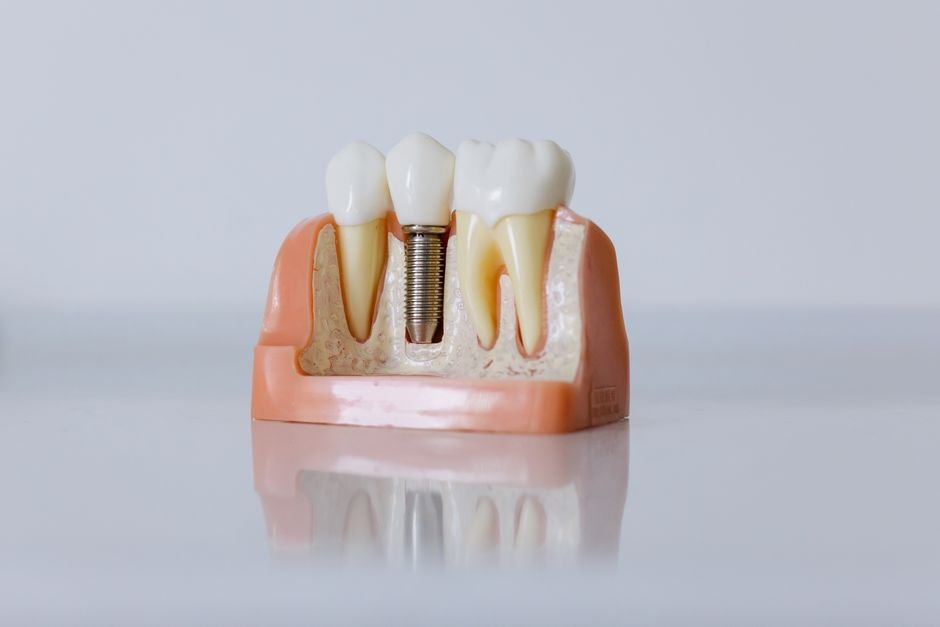
The all-on-four approach was developed as a way to replace an entire arch of teeth without needing an implant under every single missing tooth. Two implants are placed towards the front of the jaw in an upright position, while two further implants are placed further back at an angle. This angling allows the implants to engage denser sections of bone that are often still present even when the back of the jaw has lost height, which is common after teeth have been missing for some time.
Because the implants are positioned to maximise contact with existing bone, many patients who would otherwise need a bone graft before treatment can proceed directly to implant placement. A custom-made bridge, containing a full set of replacement teeth, is then attached to the four implants. This bridge is fixed in place rather than removable, so it behaves much like a natural set of teeth during eating, speaking, and daily life.
How Does the Procedure Work From Start to Finish?
Treatment usually begins with a thorough assessment, including detailed scans of the jaw, to map out bone volume, nerve position, and the ideal location for each implant. This planning stage is crucial, since the angled placement of the back implants requires precision to avoid nearby structures and to distribute biting forces evenly. Once a plan is agreed, any remaining unhealthy teeth are removed and the four implants are placed during a single surgical appointment.
Following implant placement, a temporary fixed bridge is often attached on the same day, meaning most patients do not leave without teeth. This temporary bridge allows the gums to heal and the implants to settle while still permitting reasonably normal eating and speaking. After a healing period, typically several months, during which the implants fuse with the surrounding bone, the temporary bridge is replaced with a final, more durable version that is customised for shape, colour, and bite.
Who Is a Good Candidate for All-on-Four Implants?
All-on-four is generally suited to people who are missing most or all of the teeth in an upper or lower arch, or who have teeth that are failing beyond repair due to decay, gum disease, or old age of previous dental work. It can also be an option for people who currently wear a full denture but find it unstable, uncomfortable, or difficult to chew with. A key advantage of the technique is that it can often be used even when there has been some bone loss, since the implants are angled to use the strongest remaining bone.
That said, suitability always depends on an individual assessment. Factors such as overall gum health, the presence of conditions that affect healing, smoking habits, and general medical history all play a part in deciding whether someone is a good candidate. A dentist experienced in implant dentistry will weigh up bone quality, bite alignment, and personal goals before recommending this option over alternatives such as individual implants or a removable denture.
What Happens During Recovery?
The initial recovery period after implant placement typically involves some swelling, mild bruising, and tenderness around the gums and jaw, similar to what might be expected after any minor oral surgery. Soft foods are usually recommended for the first few weeks so that the implants and surrounding tissue are not placed under excessive strain while they begin to heal. Most people find that any discomfort settles within a week or two, and normal daily activities can usually resume quite quickly.
Longer term healing, where the implants fully integrate with the jawbone, continues quietly in the background over the following months. During this phase it is important to attend any follow-up appointments so healing can be checked and the fit of the temporary bridge can be adjusted if needed. Once the dental team is satisfied that the implants are stable and well integrated, the final bridge is fitted, marking the completion of the main treatment process.
How Do All-on-Four Implants Compare to Traditional Dentures?
Traditional full dentures rest on the gums and are held in place mainly by suction and denture adhesive, which can lead to slipping, rubbing, and difficulty with certain foods. All-on-four implants, by contrast, are anchored directly into the jawbone and fixed to a bridge that does not move during eating or speaking. This generally translates into a stronger, more confident bite and a more natural sensation compared with a removable appliance sitting on soft tissue.
Another meaningful difference relates to the jawbone itself. Removable dentures do not stimulate the underlying bone, so the jaw can continue to shrink and change shape over time, which often means dentures need relining or replacing periodically. Implants, on the other hand, transmit chewing forces into the bone in a way that helps maintain its volume and density. Many people also find speech clearer with a fixed implant bridge, since there is no bulky plate covering the roof of the mouth.
How Long Do All-on-Four Implants Last?
With proper care, the implants themselves are designed to last for many years, and in many cases can remain functional for the rest of a person’s life. The titanium or ceramic implants fuse with the jawbone in a process that creates a remarkably stable foundation, similar in strength to a natural tooth root. This durability is one of the main reasons the technique has become a popular long-term solution for full arch tooth loss.
The bridge attached to the implants, however, is a prosthetic component and may need adjustment, repair, or eventual replacement after a number of years of normal wear, much like any other dental restoration. Chewing habits, grinding, and how well the bridge is cared for all influence how long it lasts before refurbishment is needed. Routine dental check-ups allow any wear on the bridge to be spotted early, before it becomes a bigger problem.
How Should All-on-Four Implants Be Cleaned and Maintained?
Even though the replacement teeth themselves cannot decay, the health of the gums and bone supporting the implants still depends on thorough daily cleaning. Special brushes, floss threaders, or water flossers are often recommended to clean underneath and around the fixed bridge, where food particles and plaque can otherwise accumulate out of sight. Brushing twice daily remains essential, with particular attention paid to where the bridge meets the gum line.
Regular professional maintenance appointments are just as important as home care. A dental team can use specialised tools to clean areas that are difficult to reach with a toothbrush alone and can check that the implants remain stable and free from inflammation. Left unaddressed, plaque build-up around implants can lead to gum inflammation that, over time, may threaten the long-term success of the implants, so consistent maintenance is a genuine priority rather than an optional extra.
What Are the Possible Risks and Complications?
As with any surgical procedure, all-on-four implant treatment carries some risk of complications, including infection, delayed healing, or, in rare cases, an implant failing to integrate properly with the bone. Temporary numbness or altered sensation can occasionally occur if a nerve is irritated during placement, although careful planning with detailed scans significantly reduces this risk. Choosing a dental team experienced in full arch implant treatment is one of the most effective ways to minimise these risks.
Longer term, the main risk relates to a condition where inflammation develops around the implant, often linked to insufficient cleaning or unmanaged gum disease elsewhere in the mouth. Smoking, uncontrolled diabetes, and teeth grinding can all increase the chances of complications developing after treatment. Because of this, an honest conversation about lifestyle factors and general health before treatment helps set realistic expectations and supports a smoother, more predictable outcome.
Frequently Asked Questions
Is the all-on-four procedure painful?
Most people report mild to moderate discomfort in the days following surgery rather than severe pain, and this is generally manageable with the pain relief recommended by the dental team. Swelling and tenderness usually peak within the first few days and steadily improve over the following one to two weeks.
Can all-on-four implants be done if I have already lost a lot of jawbone?
In many cases, yes, because the back implants are angled specifically to reach denser bone that often remains even after significant bone loss elsewhere in the jaw. A detailed scan is used to confirm whether there is enough suitable bone, and in some situations additional treatment may still be needed first.
Will I be without teeth during the healing period?
No, a temporary fixed bridge is typically attached to the implants on the same day as surgery, so most patients leave with a functional set of teeth. This temporary bridge is later replaced with the final, more durable version once healing is complete.
How is eating different with all-on-four implants compared with dentures?
Because the bridge is fixed rather than resting loosely on the gums, biting and chewing forces feel much closer to those of natural teeth, and there is no risk of the appliance shifting or slipping while eating. Some dietary caution is still advised during initial healing, but normal eating habits typically return afterwards.
What happens if an implant needs to be replaced later on?
While implant failure is uncommon when treatment is well planned and properly maintained, an individual implant can sometimes be assessed and, if necessary, replaced without needing to redo the entire arch. Regular check-ups help identify any early signs of trouble, so issues can usually be managed before they become more serious.