
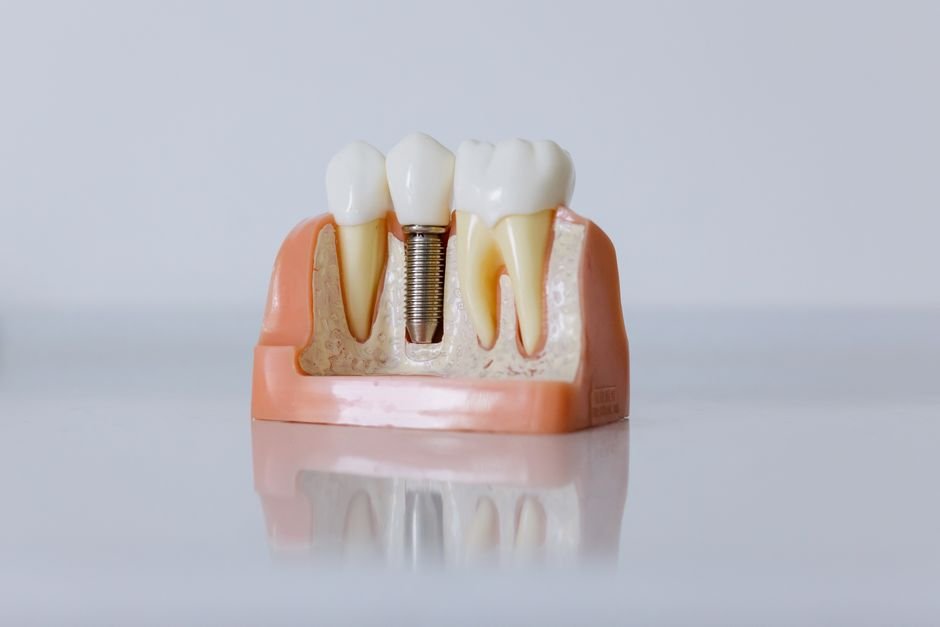
An implant abutment is the connecting piece that joins a dental implant, which sits in the jawbone, to the crown, bridge or denture that you see in your mouth. The implant acts as an artificial root, the abutment rises from it through the gum, and the visible tooth replacement is fixed onto the abutment. It holds the final restoration securely in the correct position and angle, transfers chewing forces down into the implant, and shapes the surrounding gum so the result looks natural. Although it is rarely seen once treatment is complete, the abutment plays a central role in how well an implant tooth functions, looks and lasts.
Key takeaways
- A dental implant restoration has three parts: the implant, the abutment and the crown, bridge or denture.
- The abutment connects the implant to the visible tooth and helps support healthy, natural-looking gums.
- Abutments come in stock and custom designs and are commonly made from titanium or zirconia.
- The abutment is usually fitted after the implant has bonded with the bone, though timing can vary.
- Good cleaning around the abutment and regular check-ups help protect the gums and the implant.
What are the parts of a dental implant?
A complete implant tooth is made up of three main components. The first is the implant itself, a small screw-shaped post, usually made of titanium or zirconia, that is placed into the jawbone. Over several weeks to months, the bone grows closely around its surface in a process called osseointegration, anchoring it firmly in place. The implant replaces the root of the missing tooth and provides a stable foundation.
The second component is the abutment, which attaches to the top of the implant and extends through the gum. The third is the restoration: a crown for a single tooth, a bridge for several teeth, or a denture for a full arch. Each component has a distinct job, and they are designed to fit together with great precision. Understanding this structure helps explain why implant treatment often happens in stages, and why the abutment, despite being hidden, is so important to the overall result and the long-term health of the area.
What does an abutment actually do?
The abutment has several jobs. Its most obvious role is to connect the implant to the visible tooth. It provides a solid post onto which the crown or bridge can be cemented or screwed. Because implants are not always placed at exactly the same angle as the natural tooth they replace, the abutment can also correct the angle, ensuring the final tooth sits in the right position and lines up with its neighbours.
The abutment also transfers biting and chewing forces from the crown down into the implant and the surrounding bone, much as a natural tooth root would. In addition, the part of the abutment that passes through the gum, sometimes called the emergence profile, helps shape the soft tissue around the tooth. A well-designed abutment supports a natural gum contour, which is especially important for front teeth where appearance matters. Finally, it creates a seal with the gum that helps protect the implant and bone underneath from bacteria.
What are abutments made from?
Titanium is the most widely used material for abutments. It is strong, biocompatible and has a long track record in implant dentistry. It resists fracture under chewing forces and works well with titanium implants. Its main drawback is colour: in people with thin gums, a grey shadow can sometimes show through the tissue, which may be noticeable around front teeth.
Zirconia is a tooth-coloured ceramic that offers an alternative where appearance is a priority. It is strong, well tolerated by gum tissue and does not create a dark shadow, making it popular for visible areas of the mouth. Some abutments combine materials, such as a zirconia upper part bonded to a titanium base, to balance strength with appearance. Gold alloys have also been used in some cases. Your dentist will recommend a material based on where the implant is, the thickness of your gums, the forces the tooth will face and the type of restoration being placed on top.
What is the difference between stock and custom abutments?
Stock abutments, sometimes called prefabricated abutments, are manufactured in a range of standard shapes, heights and angles. They can work very well in straightforward cases, particularly where the implant is in an ideal position and the gums have a typical shape. They are readily available and can make treatment simpler. However, because they are not tailored to the individual, they may not always provide the ideal fit or gum contour.
Custom abutments are designed specifically for a particular patient and implant. They are typically created using digital scans and computer-aided design, then milled from titanium or zirconia. This allows the dental team to control the exact shape, angle and margin position, which can improve both the fit of the crown and the appearance of the surrounding gum. Custom abutments are often preferred for front teeth, implants placed at an angle and complex cases. Your dentist will explain which option suits your situation and why, as both have a valuable place in implant treatment.
When is the abutment fitted?
In a traditional staged approach, the implant is placed first and left to bond with the bone. During this healing period, the implant may be covered by the gum, or a small healing cap may sit on top, poking through the gum. Once the implant has integrated, which commonly takes several weeks to a few months depending on the individual and the site, the abutment is attached. If the implant was covered, a minor procedure is needed to uncover it before the abutment or a healing collar is placed.
In some situations, the abutment is fitted at the same time as the implant, or a temporary tooth is attached immediately. This depends on factors such as bone quality, the stability of the implant when it is placed and the location in the mouth. Fitting the abutment is usually quick and comfortable. It is screwed securely into the implant, and the gum may be given time to settle around it before the final crown is made. Your dental team will explain the timeline for your specific treatment plan.
How is the crown attached to the abutment?
There are two main ways of attaching the visible tooth. A cement-retained crown is bonded onto the abutment with dental cement, much like a crown on a natural tooth. This can give a very natural appearance because there is no access hole in the biting surface. The main consideration is that any excess cement must be carefully removed, because leftover cement beneath the gum can irritate the tissues around the implant.
A screw-retained crown is fixed directly to the implant or abutment with a small screw that passes through the crown. The access hole is then sealed with a tooth-coloured filling material. This design makes it easier for the dentist to remove the crown in future for cleaning, repair or adjustment, without damaging it. In some systems, the abutment and crown are combined into a single piece. Each approach has advantages, and the choice depends on implant position, appearance needs and the dentist’s assessment of what will be most reliable for your mouth.
Is getting an abutment uncomfortable?
For most people, the abutment stage is one of the easier parts of implant treatment. If the abutment is simply being screwed onto an implant that is already visible through the gum, little or no anaesthetic may be needed, and patients usually feel only light pressure. If the implant has been covered by gum, a local anaesthetic is used while a small opening is made, so the procedure itself should not be painful.
Afterwards, the gum around the abutment may feel tender for a few days as it heals and adapts to the new shape. Soft foods, gentle cleaning and any pain relief recommended by your dentist usually manage this well. Rinsing with warm salt water can help keep the area clean and soothe the tissues. If you notice increasing pain, swelling that does not settle, or the abutment feels loose, contact your dentist promptly. Loosening is uncommon but should be checked, as it is usually straightforward to correct when addressed early.
How do you look after the area around an abutment?
The gum around an implant needs just as much care as the gum around natural teeth. Plaque can build up where the crown and abutment meet the gum, and if it is not removed, it can lead to inflammation of the surrounding tissues. In more advanced cases, this can affect the bone supporting the implant. Thorough daily cleaning is therefore one of the most important things you can do to protect your investment.
Brush twice a day with a soft toothbrush, paying close attention to the gumline around the implant tooth. Clean between the teeth daily using interdental brushes, implant-friendly floss or a water flosser, as advised by your dental team. Avoid smoking, which is strongly associated with gum problems around implants. Attend regular check-ups and professional cleanings so your dentist or hygienist can monitor the health of the gum and bone, check that all components remain secure and remove any hardened deposits. With good care, implant restorations can serve well for many years.
Frequently Asked Questions
What is a dental implant abutment?
A dental implant abutment is a connector that attaches to an implant in the jawbone and extends through the gum. It provides a secure base for the crown, bridge or denture, holds the replacement tooth at the correct angle and helps shape the surrounding gum for a natural appearance.
Can you see the abutment once the crown is fitted?
In most cases the abutment is not visible once the crown is in place, because it is covered by the crown and surrounded by gum. In people with thin gums, a titanium abutment can occasionally create a slight grey shadow, which is why tooth-coloured zirconia abutments are often used for front teeth.
How long after implant surgery is the abutment placed?
In a staged approach, the abutment is usually placed once the implant has bonded with the jawbone, which commonly takes several weeks to a few months. In some cases, the abutment is attached at the same appointment as the implant. Your dentist will decide the timing based on bone quality and implant stability.
Can an implant abutment come loose?
An abutment can occasionally loosen, usually because the retaining screw has worked loose over time or due to heavy biting forces. It is not common, and it can normally be tightened or replaced easily. If an implant tooth feels wobbly or moves, contact your dentist promptly so it can be checked.
How should I clean around an implant abutment?
Brush twice daily with a soft toothbrush, focusing on the gumline around the implant tooth, and clean between the teeth every day with interdental brushes, implant-friendly floss or a water flosser. Regular dental check-ups and professional cleans help keep the gum and bone around the implant healthy.